





Every grilling recipe ever written is quietly answering one question: does this food cook over the fire, or beside it? That’s direct versus indirect heat, and once you can read a recipe for the answer — or decide it yourself — you can grill almost anything with confidence.
Direct heat: cooking over the fire
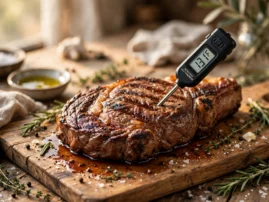
Direct heat means the food sits right above the flames or coals. It’s fast, it’s hot, and it’s where browning happens — the sear on a steak, the char on corn, the blister on asparagus. Think of it as the grill’s stovetop burner.
Direct heat suits food that is thin, small, or quick: steaks and chops up to about an inch thick, burgers, hot dogs and sausages, skewers, shrimp and scallops, most vegetables, and anything you want marked and done in under 20 minutes or so.
Its weakness is just as clear: the outside cooks far faster than the inside. A thick steak left over direct heat the whole way ends up black outside and cold in the middle — which is why so many recipes pair direct with indirect instead of choosing one.
Indirect heat: cooking beside the fire
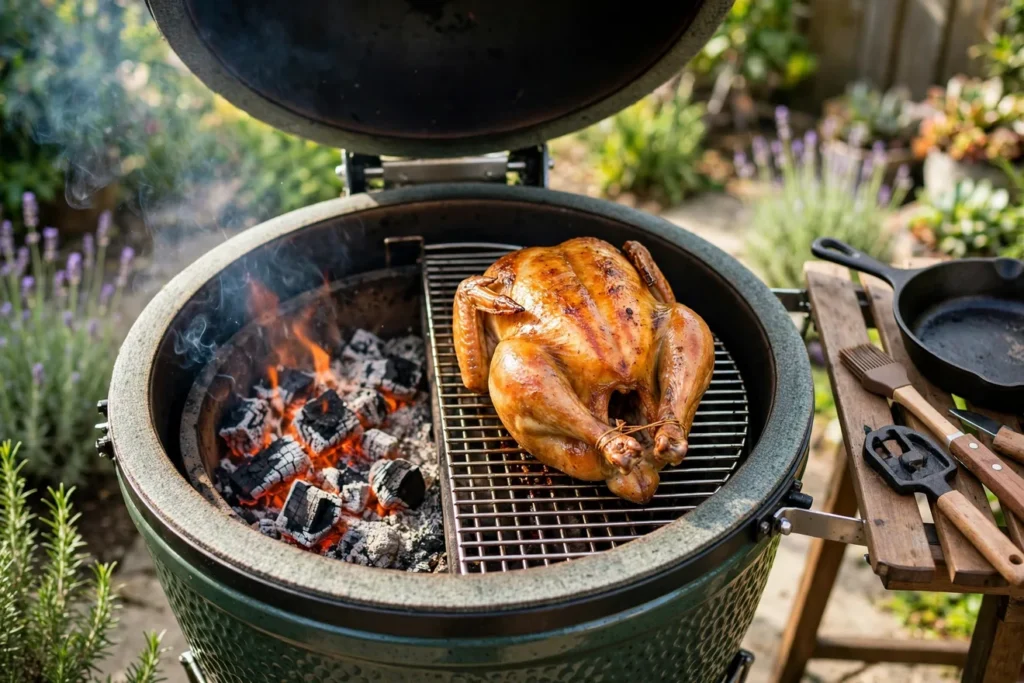
Indirect heat means the food sits away from the fire, and the closed lid turns the grill into an oven — hot air circulates, and food cooks evenly from all sides. It’s slower and gentler, and it’s where big food becomes possible: whole chickens, pork shoulders, ribs, roasts, whole fish, and anything that needs more than about 25 minutes.
Think of indirect as the grill’s oven and direct as its burner, and a cookout becomes a kitchen you already understand. The setup that gives you both at once is the Two-Zone Fire — hot side and cool side on the same grate.
The deciding questions
When a recipe doesn’t say — or when you’re improvising — three questions settle it:
- How thick is it? Under an inch, direct can carry it. Over an inch and a half, plan on indirect time. In between is combo country: sear direct, finish indirect.
- How long does it need? If the honest answer is more than 25–30 minutes, indirect does the heavy lifting; direct-only food would burn before it finished.
- How delicate is it? Whole fish, skin-on chicken, and anything stuffed or sugary (glazes burn fast) all appreciate indirect gentleness, at least to start or finish.
The combo, in real plates
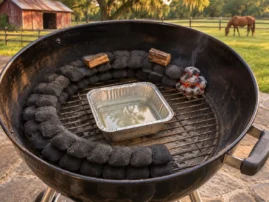
Most of the best plates on this site use both, in one order or the other. Pork neck and steaks: sear direct, finish indirect to the exact temperature on the Temperatures Chart. Wings: start indirect so the fat renders, finish direct for crisp skin. Ribs and shoulders: indirect for hours, with direct heat only at the very end, if at all — the Snake Method is indirect cooking in its purest form.
Learn to see the two heats in every recipe and the whole library opens up: the method stops being instructions you follow and starts being a decision you understand.
Sources: standard technique as taught by the grill manufacturers’ own guides (Weber, Big Green Egg) and practiced across this site’s recipes.