






Barbecue was born in the Caribbean, where the Taíno people slow-cooked meat over fire and smoke on a raised wooden frame called a barbacoa. Spanish explorers carried that word — and their pigs — across the ocean, and when European livestock met Native American smoke in North America, something brand new began. What grew out of that meeting over the next four hundred years is the barbecue we know and love today: Carolina whole hog, Memphis ribs, Texas brisket, and family gathered around a backyard grill.
Cooking over fire is as old as fire itself — barbecue was probably invented by the wife of the first caveman to bring home a flame. Every culture since has added its own flavors and character. This is the story of how it happened in North America.
The Word Barbacoa
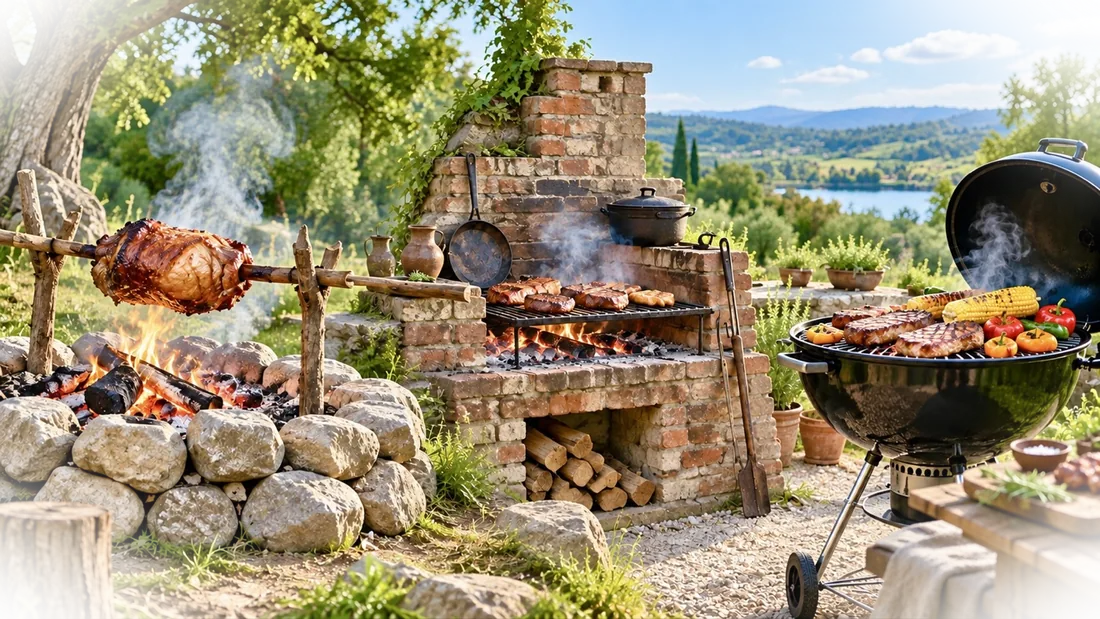
Barbecue, or bar-b-que, or BBQ — or a “Barbie,” for our friends down under — can mean a lot of things. But the word itself comes from the Taíno people of the Caribbean. Their word, barabicu, named the wooden framework they cooked on: green sticks lashed across four posts, set over a fire so meat could cook and smoke slowly up off the ground. In other words, the very first barbecue was the grill itself.
Spanish explorers watched the Taíno cook this way and took the word home as barbacoa — it first appeared in print in 1526. From Spanish it passed into English in the 1600s as “barbecue,” and it has been growing ever since. You’ll sometimes hear that barbacoa meant “sacred fire pit.” It’s a fine story, and the Taíno surely took their cooking seriously — but the word named the wooden frame, not the fire. The dictionary today still gives barbecue three meanings: a grill or pit for roasting meat, a whole animal roasted over an open fire, and a social gathering outdoors where food is cooked over flame. Five hundred years later, all three are still true.
Fire Meets the New World
Our story starts with Christopher Columbus. On his second voyage in 1493, Columbus stopped in the Canary Islands and took aboard eight pigs. It was a smart pick. Pigs were compact, traveled well, multiplied quickly, ate just about anything, and adapted easily to the tropical environment — perfectly suited for island life. A chronicler of the time, Bartolomé de las Casas, later wrote that all the thousands of pigs in the Indies descended from those eight.
But the real father of pork in the New World was Hernando de Soto, who landed near Tampa Bay, Florida, in 1539 with thirteen pigs. By the time of his death three years later, De Soto’s herd was said to have grown to over 700 — not counting the ones his men had eaten, or the ones that escaped into the wilds of what is now the southeastern United States. The University of Arkansas Razorbacks have a Spanish treasure hunter to thank for their mascot.
Other Spaniards seeking fame and gold brought cattle. Hernán Cortés brought cattle and pigs to what is now Mexico, and over time those herds moved north into the Great Plains, taking over country where the buffalo roamed. All that good meat on the hoof didn’t escape the attention of the people already living here — some of the hardest fights De Soto’s expedition faced were over Native attempts to make off with his herd. They knew a good thing when they saw one.
Nowhere did the pig take hold like the South. In the years before the Civil War, pork was the number one meat on the Southern table. Hogs could be turned loose in the forest to root for themselves and rounded up when supplies ran low. Every part of the pig was used, from the snout to the tail, and hog-killing time became a neighborhood celebration. Very little of it was ever exported — Southern pork fed Southern families, and by some estimates a Southerner ate five pounds of pork for every one pound of beef.
Native American Smoke and Jerk
The Spanish brought the hog, but the smoke was already here. Native peoples across the Americas had been slow-cooking meat with wood smoke for centuries before any European sail appeared — to flavor it, tenderize it, and preserve it in a world without refrigeration. As South Carolina barbecue folks tell the story, the two traditions first came together in the 1560s around Santa Elena, a Spanish colony near modern-day Parris Island, where Spanish pigs met coastal tribes who knew exactly what to do with them over a slow fire. Smoke-cooked barbecue is still the preferred way to cook in the South, and it may explain why the Carolinas are known today for such a variety of styles.
The island cooks reached their own pinnacle of barbecue perfection in Jamaica with jerked pork. There, Taíno slow-smoking methods met the traditions of the Maroons — Africans who had escaped enslavement and taken to the mountains — who seasoned wild pig with allspice and fiery peppers and cooked it low and slow over pimento wood after a long marinating in a spicy rub. And when barbecue traveled north into the colonies, many of its first masters were enslaved Africans, who combined their own cooking knowledge with the Caribbean techniques and kept the tradition alive. American barbecue has never had just one author — it has always been a meeting of cultures around a fire.
By the 1700s, a “barbecue” in the colonies also meant the gathering itself. Whole hogs went over long pits for elections, harvests, church socials, and holidays, and the cooking took hours — sometimes days — because the eating was only half the point. That part hasn’t changed either.
The Regional Map
As you move west, the regional distinctions multiply — right down to what kind of meat belongs on the pit.
The Carolinas
Carolina barbecue is pork, and the argument is over the sauce. Near the coast it’s a thin vinegar-and-pepper sauce over whole hog. In central South Carolina, German and French settlers left their mark in a mustard-based sauce the color of gold. And in Lexington, North Carolina, you’ll find more than one barbecue restaurant for every 1,000 citizens — which is why Lexington calls itself, proudly and self-proclaimed, the “Barbecue Capital of the World.” Their style is pork shoulder over hickory, dressed with a vinegar “dip” touched with tomato.
Memphis
In Memphis, Tennessee, when somebody says barbecue, they’re probably talking about ribs — slow-cooked with a rub and a light mop, served sauced or “dry” with the rub alone. Head west and the sauces start getting thicker, sweeter, and more tomato-based, helped along by the molasses that moved up and down the river trade.
The Mississippi River Divide
When you reach the Mississippi River, you cross the barbecue border. East of the river, barbecue is pork. West of the Mississippi, cattle is king.
Texas
It’s easy to imagine the birth of barbecue in Texas: large expanses of prairie, a big fire, and a nice slab of beef are the perfect ingredients. And because everything is bigger in Texas, there is no one “Texas style.” In the eastern part of the state, barbecue resembles its eastern neighbors — slow-cooked with smoke from hickory, oak, or pecan wood, with a sweet tomato-based sauce. In Central Texas, they slow-cook brisket, sausage, and ribs, known as the “Holy Trinity” of meats. In West Texas it’s mesquite wood and more direct heat. And along the southern border there’s a Mexican influence, with meat slow-cooked in a barbacoa pit — the old word, come home again.
Kansas City
Kansas City was a late entry to barbecue, but it made up for lost time. The city’s style traces to Henry Perry, a Tennessee-born steamboat cook who began selling smoked meats in Kansas City in 1908 — hot meat wrapped in newspaper for twenty-five cents, with a sauce described at the time as harsh and peppery. Perry taught the trade to the cooks who followed him, including the men behind Arthur Bryant’s, and Kansas City became the place that smokes just about anything: beef, pork, sausage, poultry, and even sometimes fish, under a thick tomato-and-molasses sauce. Perry was generous with more than knowledge, too — in 1920 he fed a thousand veterans, widows, and orphans free of charge. Kansas City makes its own claim to “World’s Barbecue Capital” — and after a plate of their burnt ends, you may not argue.
Barbecue vs. Grilling vs. Smoking
So what separates the three? True barbecue is cooked slowly over coals with indirect heat — the fire off to the side, the meat in no hurry, temperatures low for hours on end. Grilling is the opposite: fast cooking over coals with direct heat, minutes instead of hours. Smoking, or hot smoking, combines wood smoke and low heat for a slow-cooked, flavorful result. Same fire, three different philosophies — and on this site, we love them all.
New to the fire yourself? Our Grilling 101 guides walk you through the basics, step by step.
The Best Barbecue in the World
Regardless of your preference in styles, the best barbecue in the world is the one cooked around friends and family in your backyard. So whether it’s beef, poultry, or fish, cooking over fire is one of the best forms of cooking there is — and placing these foods over the grill shows exactly why this tradition continues to gain popularity worldwide.
Frequently Asked Questions
Where did barbecue originate?
Barbecue began in the Caribbean, where the Taíno people slow-cooked meat on a wooden framework over fire and smoke. Spanish explorers carried the technique and the word to North America in the 1500s, and the regional styles we know today developed in the American South and West over the following centuries.
What does “barbacoa” mean?
Barbacoa comes from the Taíno word barabicu, which named the raised wooden frame — green sticks lashed across posts — that the Taíno used to cook and smoke meat over a fire. Spanish explorers adopted the word, and it became “barbecue” in English.
Who brought pigs to America?
Christopher Columbus carried the first pigs to the Caribbean on his second voyage in 1493, taking eight aboard in the Canary Islands. Hernando de Soto brought pigs to the North American mainland, landing in Florida in 1539 — which is why he’s often called the father of the American pork industry.
What are the main regional barbecue styles?
The Carolinas cook pork with vinegar-based sauce (and a mustard sauce in central South Carolina). Memphis is famous for ribs, dry-rubbed or sauced. Texas is beef country, built on brisket. Kansas City smokes a little of everything under a thick, sweet tomato-and-molasses sauce.
Is grilling the same as barbecue?
No — though the words get mixed up at every cookout. Grilling is fast cooking over direct heat. Barbecue is slow cooking over indirect heat, usually with wood smoke, for hours. If it takes all afternoon, it’s barbecue.