






Best for: Steak night with an Isaan accent — one great cut, a fierce little sauce, and sticky rice to chase it.
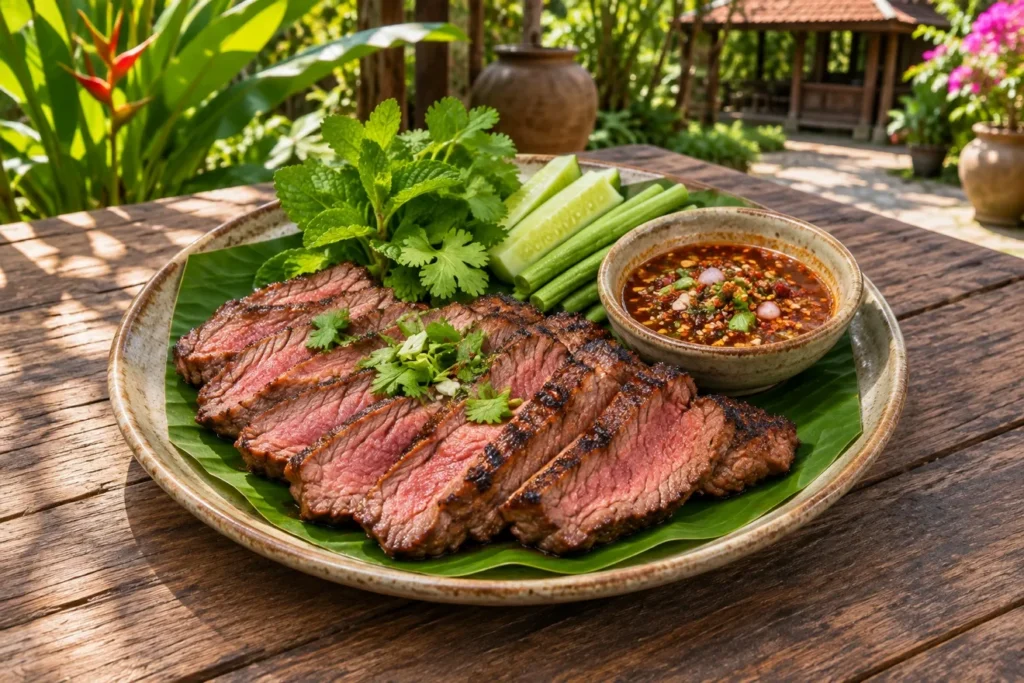
Suea rong hai — crying tiger — is Isaan’s grilled beef legend: a well-marbled cut marinated in fish sauce and palm sugar, charred hard over charcoal, sliced, and served with nam jim jaew, the toasted-rice chili dip. The name has a dozen stories — the tiger wept because the beef was too good to leave, or because the chili heat got him — and every version ends the same way: sliced beef, sour heat, sticky rice. Use a cut with real marbling; the fat is where the tiger story lives.
Grill: Direct, high heat (about 450–500°F) over charcoal. On a gas grill, preheat on high to the same temperature and keep the lid down between turns. Equipment: Charcoal grill, instant-read thermometer, small dry skillet (for the rice powder). Course: Main dish.
Ingredients
Rest: 10 minutes Total: 1 hour 5 minutes.
Not sure when it’s done? Check the grilling temperatures & doneness chart.
For the beef
- 1 1/2 pounds ribeye, strip, or flank steak, about 1 inch thick
- 2 tablespoons fish sauce
- 1 tablespoon soy sauce
- 1 tablespoon palm sugar (or brown sugar)
- 1/2 teaspoon black pepper
- 1 teaspoon neutral oil
For the jaew
- 1 tablespoon uncooked sticky rice (or jasmine rice)
- 3 tablespoons fish sauce
- 2 tablespoons tamarind paste
- 1 tablespoon lime juice
- 1 tablespoon palm sugar (or brown sugar)
- 1 to 2 teaspoons Thai chili flakes, to taste
- 1 small shallot, finely sliced
- 2 tablespoons chopped cilantro and scallion greens
Directions
Toast the rice powder. Toast the uncooked rice in a dry skillet over medium heat, stirring, until deep golden and nutty-smelling, 5–7 minutes. Cool, then grind to a coarse powder. This khao khua is the jaew’s signature — do not skip it.
Stir the jaew together. Stir the fish sauce, tamarind, lime juice, and palm sugar until dissolved. Add the chili flakes, shallot, herbs, and 1 tablespoon of the rice powder. It should taste sour first, then salty, then hot. (See the full standalone Nam Jim Jaew recipe.)
Marinate the beef. Rub the beef with the fish sauce, soy sauce, palm sugar, pepper, and oil. Rest at room temperature 30 minutes while the grill heats — a short marinade is traditional here; the sauce does the heavy lifting.
Char it hard. Grill over high charcoal heat 4–5 minutes per side, building a dark, smoky crust. We recommend pulling the beef at 145°F with its rest. Personal-preference note: many cooks serve crying tiger rosy at 130–135°F for medium-rare, which is below the USDA-recommended 145°F — a knowing choice, never an accident.
Rest it properly. Rest 10 minutes so the juices settle back into the meat. Slice-happy cooks lose half the plate’s juiciness on the board.
Slice and serve with jaew. Slice against the grain into bite-size strips, fan over a warm plate, and spoon a little jaew over the top with the rest in a bowl for dipping. Sticky rice alongside, always.
Grilling tip: The jaew’s toasted rice powder goes in at the last minute — stirred in early, it swells and turns the sauce pasty. Powder last, serve now.
Crying Tiger, Questions Answered
Why is it called crying tiger? Nobody knows for sure — the name has a dozen stories. In one, the beef was so good the tiger wept at leaving it; in another, the chili heat got him. Every version ends the same way: sliced beef, sour heat, sticky rice.
What cut works best? A well-marbled cut about an inch thick — ribeye, strip, or flank. The fat is where the flavor lives; a lean cut dries out under this hard a char.
Can I make it on a gas grill or in a pan? Yes. On gas, preheat on high to 450–500°F and grill with the lid down between turns. A ripping-hot cast-iron skillet on the stove will give you the crust — open a window first; it will smoke.
What do I serve with it? Sticky rice, always — it chases the heat and catches the sauce. Spoon a little jaew over the sliced beef and put the rest in a bowl for dipping.
What are tamarind paste and palm sugar? Tamarind paste is the sour backbone of the jaew — find it in the international aisle or an Asian market. Palm sugar is a mild, caramel-tasting sugar sold in jars or discs in the same aisle; light brown sugar swaps in measure for measure, as the recipe notes.